- myFICO® Forums
- FICO Scoring and Other Credit Topics
- Understanding FICO® Scoring
- Re: Does store card lower score?
Options
- Subscribe to RSS Feed
- Mark Topic as New
- Mark Topic as Read
- Float this Topic for Current User
- Bookmark
- Subscribe
- Mute
- Printer Friendly Page
Turn on suggestions
Auto-suggest helps you quickly narrow down your search results by suggesting possible matches as you type.
Showing results for
Does store card lower score?


Is your credit card giving you the perks you want?
Browse credit cards from a variety of issuers to see if there's a better card for you.

- Mark as New
- Bookmark
- Subscribe
- Mute
- Subscribe to RSS Feed
- Permalink
- Report Inappropriate Content
12-27-2015
01:19 PM
12-27-2015
01:19 PM
Re: Does store card lower score?
@Anonymous wrote:Here's an interesting question about "store cards." It's clear that a Target card is a store card. It's a card that is not only associated with Target but actually can only be used there.. It's also clear that a Chase Freedom or a Citi Doublecash are major credit cards -- absolutely not store cards. They are not associated with any store and they can also be used at a wide variety of stores (grocery stores, gas stations, restaurants, etc.).
But it seems like there are cards that fall in between. The card is strongly linked to a particular store (it has that store's icon and logo on it) but it also has a major CC icon on it (e.g. Amex or Visa or MC). Are these hybrid cards classified as Retail cards or non-retail major cards?
I didn't get a boost with my NextGen score when I was approved for the Target Redcard. Six months later when I was approved for the Lowes card, I had a substantial boost to my NextGen score. There was a lot happening on my report at the time, but most of it should have been more negative. I think that is good evidence NextGen doesn't count Target a store card. Lowes shows up on my credit reports as a Charge card, not credit card.
LN could override the credit card coding in the credit report for the RedCard. I saw they had two types of store cards listed in there codes. I don't remember the exact details. IIRC, one was department store cards. The other was big purchase cards like jewlery and furniture. Maybe the second category was LN's consumer finance category.
Message 11 of 32
0
Kudos

Anonymous
Not applicable
- Mark as New
- Bookmark
- Subscribe
- Mute
- Subscribe to RSS Feed
- Permalink
- Report Inappropriate Content
12-27-2015
01:35 PM
12-27-2015
01:35 PM
Re: Does store card lower score?
Hey CD. So what is your guess as to how a co-branded card is classified?
Like a Sam's Amex or a Best Buy Master Card or a Home Depot Visa?
Would they all be treated as non-store cards (because of their status as a major CC) or would they be treated as store cards because of the fact that they were issued through a store -- or would some be classified one way and some another without any clear pattern?
The answer to the question might help a person who is trying to take practical steps to lower the amount of "store cards" he has.
Message 12 of 32
0
Kudos
- Mark as New
- Bookmark
- Subscribe
- Mute
- Subscribe to RSS Feed
- Permalink
- Report Inappropriate Content
12-27-2015
01:55 PM
12-27-2015
01:55 PM
Re: Does store card lower score?
@Anonymous wrote:Thom Thumb is the guy who knows more about the LexisNexis insurance model codes than anybody else here I think -- with the exception of you, CD! :-)
He sent me a link to for the auto insurance and a link for the home insurance codes. Boy, were there a lot! I have been unable to find those links (I forgot to save them). I'd love to see them again, so if TT is reading this and wants to chime in, that would be great.
My memory about the "average CL" factor is that it was the average CL of revolving lines (period). Thus it would have counted both store cards and non-store cards when it made that computation. If so, a typical store card would be spanked twice: once for being a store card and again for lowering your Average CL (since store cards typically have low CLs compared to a major CC).
I very well could be wrong about that, however. Maybe (as you say) the Average CL factor only looks at the average CL of non-retail cards.
One fascinating thing I noticed (when I first skimmed through the codes) is that there were a series of codes devoted to spanking you for having an installment loan as your oldest account rather than a credit card. Apparently the LN model wants your oldest account to be a credit card rather than (say) a mortgage or a student loan. If I remember right, the LN model looks at the age of your oldest CC and divides that by the age of your oldest account. If your oldest account is a credit card, then the ratio will be exactly 1. If you have an installment loan as your oldest account, then the ratio will be < .99999999. The lower the ratio is, the more you get spanked. But you do get spanked even if the ratio is just under 1 (e.g. 0.99)
I will be spanked for a long time for this since my oldest account is a student loan and I doubt it will fall off for another 12 years.
I love your idea of putting together a summary of actionable advice for people who feel like improving their insurance scores. That's awesome.
Just did a quick google search. I found the following links:
Depending on which codes you click on, there is a PDF for home and auto insurance codes:
Home:
Auto:
Code 3300 is the one I singled out. Looking closer it looks like codes 3030 - 3040 are for Bank Revolving lines up to $7,500 (auto insurance). Codes 3295 - 3300 are for Bank Revolving lines up to $13,001 (home insurance).
I didn't notice the bit about getting spanked if your oldest TL was an installment loan. I think you are talking about codes 3024 - 3029 (auto) or maybe codes 3489 - 3491 (home). Reading it now, I think it will also penalize you if your oldest account is a retail card or installment loan.
There is an awful lot of codes to go through. I just saw codes for having at least 7 CU or Mortgage accounts. I will really need to look at it more later.
Edit: I found there are actually two PDF files available. One for Home insurance codes and one for Auto insurance codes. I have updated the post to reflect it. The first web page shown combines codes for both auto and home insurance codes. It means we have about 150 pages of codes to read through to start to understand what LN is measuring.
Message 13 of 32
0
Kudos
- Mark as New
- Bookmark
- Subscribe
- Mute
- Subscribe to RSS Feed
- Permalink
- Report Inappropriate Content
12-27-2015
02:05 PM
12-27-2015
02:05 PM
Re: Does store card lower score?
@Anonymous wrote:Hey CD. So what is your guess as to how a co-branded card is classified?
Like a Sam's Amex or a Best Buy Master Card or a Home Depot Visa?
Would they all be treated as non-store cards (because of their status as a major CC) or would they be treated as store cards because of the fact that they were issued through a store -- or would some be classified one way and some another without any clear pattern?
The answer to the question might help a person who is trying to take practical steps to lower the amount of "store cards" he has.
I think you can tell by how the TL is reported. If it is reported as a credit card, then it is a normal credit card. If it is reported as a charge card, then it is a store card.
I also think FICO 04 looks at the credit card lender. Cards from CU's and small banks aren't weighted as heavily as cards from national banks. However, it is best to have CU and national bank cards for FICO 04. At least that is what I remember reading from an interview that FICO put out years ago. The interview is the only place I have ever seen it stated FICO 04 has a credit mix bonus for having both CU and national bank cards. I couldn't find the article the last time I searched for it. There are plenty of MF old posts showing disgust that a $250 CL FirstPremier card is better for your mortgage FICO score than a Penfed 25k card.
Message 14 of 32
0
Kudos

- Mark as New
- Bookmark
- Subscribe
- Mute
- Subscribe to RSS Feed
- Permalink
- Report Inappropriate Content
12-27-2015
04:27 PM
12-27-2015
04:27 PM
Re: Does store card lower score?
Regarding department store & retail cards - they are looked at differently from one another according to LN CBIS reason scores. Not really sure how they are identified by the models as pulled from the credit reports.
I do have an open BB card [not cobranded - good for use at BB only] that shows up in the credit card category. However, I believe it is classified as a store card. The CBIS does look at closed accounts for card classification as well. I have a closed Kohls card that is still on file and it is hurting my CBIS score. An old closed BB card - strictly a charge card - was removed [purged] from my CB reports in November - one closed retail card left to go. Auto & Property scores rose 27 and 15 points, respectively.
Note: LN Auto and Property CBIS models look at cards differently - it is rather convoluted IMO. [Is Kohl's department store and BB retail? Not really sure)
The below codes were listed on both my October and December report
0137 | # OF RETAIL ACCOUNTS ESTABLISHED...more info |
0165 | % OF ALL DEPART STORE ACCTS REPORTED IN LAST 24 MOS TO TOTAL # ACCTS...more info |
0137 | Number of Retail Accounts Established Auto - 0 is better [I have 2, one open & one closed] 1. What information is this message derived from? The number of accounts established (regardless of timeframe) with retail stores. Retail accounts refer to clothing stores, jewelers, home furnishings, mail order and variety stores. 2. How does this affect my insurance risk score? Insurance industry research shows that consumers who open accounts with retailers have more insurance losses. 3. What can I do to improve this aspect of my score? Once you have opened the account and regardless of whether you use it or not, your score will be impacted by this factor. Open new accounts only when needed.
|
0165 | Percent of All Department Store Accounts Reported in the Last 24 Mos to Total # of Accts Property - More than 56% is better [I have one that is closed - so this will always compute as 0% until it is purged] 1. What information is this message derived from? Of all accounts on file, the percent of those accounts with department stores that have been active and have had no late payments in the last 24 months. A department store account is generally a major department store such as JC Penney, Bloomingdale’s, etc. 2. How does this affect my insurance risk score? Insurance industry research shows that consumers who with recent experience paying their department store accounts on time have fewer insurance losses. 3. What can I do to improve this aspect of my score? Recent satisfactory activity on your accounts shows your ability to manage your credit obligations.
|
Some unusual Auto reason codes/statements worth noting:
1) Length of time department store accounts are open (codes 3070 - 3081).
30701 | Total Length of Time Department Store Accounts in File is 39 to 236 Months [I have a closed Kohls, age 84 months] |
| Having no Department Store Accounts is Better |
| 1. What information is this message derived from? Using the date opened on accounts identified as department stores. These are primarily major department stores such as JCPenney, Bloomingdale’s, Macy's, etc. The score considers how long these accounts have been established. Any type of department store account (even those currently closed) is included. |
| 2. How does this affect my insurance risk score? Insurance industry research shows that consumers who have a long established account history with department stores have more insurance losses. |
| 3. What can I do to improve this aspect of my score? This component of your score may improve when the account is purged from your credit report. |
2) Number of department store cards on file (3082 - 3084)
3082 - # of Open Department Store Accounts is 2 [No open department store cards - not a code in my report] |
|
1 or 0 Open Department Store Accounts is Better | |
1. What information is this message derived from? The score considers the number of open/active department store accounts. Department store accounts refer to JCPenney, Bloomingdale’s, Macy’s, etc. A revolving type department store account is considered open if it has been reported (even with no activity) in the last 12 months and not reported as closed. Installment type accounts must have a balance greater than $0 to be considered open. | |
2. How does this affect my insurance risk score? Insurance industry research shows that consumers who utilize department store accounts to purchase merchandise have more insurance losses. | |
3. What can I do to improve this aspect of my score? Consider using fewer sources of credit to make purchases. |
3) Number of open accounts (cards + non mortgage installment loans) - (3137 - 3142)
3138 | # of Accounts that are Open is 7 to 8 [Open I have 5 cards + 1 AU card + 1 mortgage] |
| 5 or Less Open Accounts is Better |
| 1. What information is this message derived from? The score considers the number of accounts that are open/active. An account is considered open if it has been reported in the past 12 months and has not been reported as closed. Revolving accounts need not have a balance to be considered open/active. Installment accounts must have a balance and must have been reported by the creditor in the past 12 months and be considered open. |
| 2. How does this affect my insurance risk score? Insurance industry research shows that consumers who maintain open/active accounts experience fewer insurance losses. |
| 3. What can I do to improve this aspect of my score? Consider keeping some of your accounts active, especially the account that you have had the longest. Managing your credit obligations in a responsible manner indicates that you are a lower risk. |
Fico 9: .......EQ 850 TU 850 EX 850
Fico 8: .......EQ 850 TU 850 EX 850
Fico 4 .....:. EQ 809 TU 823 EX 830 EX Fico 98: 842
Fico 8 BC:. EQ 892 TU 900 EX 900
Fico 8 AU:. EQ 887 TU 897 EX 899
Fico 4 BC:. EQ 826 TU 858, EX Fico 98 BC: 870
Fico 4 AU:. EQ 831 TU 872, EX Fico 98 AU: 861
VS 3.0:...... EQ 835 TU 835 EX 835
CBIS: ........EQ LN Auto 940 EQ LN Home 870 TU Auto 902 TU Home 950
Fico 8: .......EQ 850 TU 850 EX 850
Fico 4 .....:. EQ 809 TU 823 EX 830 EX Fico 98: 842
Fico 8 BC:. EQ 892 TU 900 EX 900
Fico 8 AU:. EQ 887 TU 897 EX 899
Fico 4 BC:. EQ 826 TU 858, EX Fico 98 BC: 870
Fico 4 AU:. EQ 831 TU 872, EX Fico 98 AU: 861
VS 3.0:...... EQ 835 TU 835 EX 835
CBIS: ........EQ LN Auto 940 EQ LN Home 870 TU Auto 902 TU Home 950
Message 15 of 32
Anonymous
Not applicable
- Mark as New
- Bookmark
- Subscribe
- Mute
- Subscribe to RSS Feed
- Permalink
- Report Inappropriate Content
12-27-2015
06:20 PM
12-27-2015
06:20 PM
Re: Does store card lower score?
@Thomas_Thumb wrote:
3) Number of open accounts (cards + non mortgage installment loans) - (3137 - 3142)
3138
# of Accounts that are Open is 7 to 8
5 or Less Open Accounts is Better
1. What information is this message derived from? The score considers the number of accounts that are open/active. An account is considered open if it has been reported in the past 12 months and has not been reported as closed. Revolving accounts need not have a balance to be considered open/active. Installment accounts must have a balance and must have been reported by the creditor in the past 12 months and be considered open.
2. How does this affect my insurance risk score? Insurance industry research shows that consumers who maintain open/active accounts experience fewer insurance losses.
3. What can I do to improve this aspect of my score? Consider keeping some of your accounts active, especially the account that you have had the longest. Managing your credit obligations in a responsible manner indicates that you are a lower risk.
Thanks TT. The strangest reason code you just posted was the one I show above. It's strange because its seems to be giving mixed message as to whether having several open/active accounts is good.
It flags you for having 7-8 open accounts, and then tells you that 5 or Less Open Accounts is better. OK, thus far so good. The algorithm must dislike a person having more than a small number of open accounts.
But then in the explanatory text (relevant pieces in blue boldface) it implies that it is trying to punish consumers who have FEW open/active accounts.
Message 16 of 32
0
Kudos
- Mark as New
- Bookmark
- Subscribe
- Mute
- Subscribe to RSS Feed
- Permalink
- Report Inappropriate Content
12-27-2015
06:45 PM
12-27-2015
06:45 PM
Re: Does store card lower score?
@Anonymous wrote:
@Thomas_Thumb wrote:
3) Number of open accounts (cards + non mortgage installment loans) - (3137 - 3142)
3138
# of Accounts that are Open is 7 to 8
5 or Less Open Accounts is Better
1. What information is this message derived from? The score considers the number of accounts that are open/active. An account is considered open if it has been reported in the past 12 months and has not been reported as closed. Revolving accounts need not have a balance to be considered open/active. Installment accounts must have a balance and must have been reported by the creditor in the past 12 months and be considered open.
2. How does this affect my insurance risk score? Insurance industry research shows that consumers who maintain open/active accounts experience fewer insurance losses.
3. What can I do to improve this aspect of my score? Consider keeping some of your accounts active, especially the account that you have had the longest. Managing your credit obligations in a responsible manner indicates that you are a lower risk.
Thanks TT. The strangest reason code you just posted was the one I show above. It's strange because its seems to be giving mixed message as to whether having several open/active accounts is good.
It flags you for having 7-8 open accounts, and then tells you that 5 or Less Open Accounts is better. OK, thus far so good. The algorithm must dislike a person having more than a small number of open accounts.
But then in the explanatory text (relevant pieces in blue boldface) it implies that it is trying to punish consumers who have FEW open/active accounts.
I thought it was a fairly strange code, too. There is another code for the number of accounts with pays as agreed. If you have less than 10 accounts, you are dinged. I figured the penalty for having more than 5 accounts was to counteract one of the ways LN calculates number of good payments. They add up the number of good payments you made. The more accounts you have the more payments you make.
Message 17 of 32
0
Kudos
- Mark as New
- Bookmark
- Subscribe
- Mute
- Subscribe to RSS Feed
- Permalink
- Report Inappropriate Content
12-27-2015
07:14 PM
12-27-2015
07:14 PM
Re: Does store card lower score?
Yes, it is rather convoluted. Best I can tell is optimal fot CBIS would be: something like:
4 open bank cards (Discover & AMEX ok) with one open car loan (or mortgaage).+ 2 or 3 closed car loans and a couple closed non store credit cards. Overall, want total CL of open cards divided by total cards open+ closed above $10k for max score potential. It is very strange but - it doers kind of read that the model divides by total CC accounts on file (not just open). Also, youngest CC account should be 4 years age or more.
My current LN scores are Auto = 900 out of 997 and Property = 870 out of 997. I would be rather interested if CGID, Inverse or CD had LN scores they could offer up. Unfortunately, the cost $12.95 each.
As mentioned, TU CBIS Auto scores are available free through CK but, the only way I got TU Home CBIS was by paying for trial credit monitoring and then canceling it. I have a TU reason code sheet and it is much more logical with a fraction of the reason codes. Even so, TU CBIS also looks at average card CL and store cards are flagged as a negative as well..
Fico 9: .......EQ 850 TU 850 EX 850
Fico 8: .......EQ 850 TU 850 EX 850
Fico 4 .....:. EQ 809 TU 823 EX 830 EX Fico 98: 842
Fico 8 BC:. EQ 892 TU 900 EX 900
Fico 8 AU:. EQ 887 TU 897 EX 899
Fico 4 BC:. EQ 826 TU 858, EX Fico 98 BC: 870
Fico 4 AU:. EQ 831 TU 872, EX Fico 98 AU: 861
VS 3.0:...... EQ 835 TU 835 EX 835
CBIS: ........EQ LN Auto 940 EQ LN Home 870 TU Auto 902 TU Home 950
Fico 8: .......EQ 850 TU 850 EX 850
Fico 4 .....:. EQ 809 TU 823 EX 830 EX Fico 98: 842
Fico 8 BC:. EQ 892 TU 900 EX 900
Fico 8 AU:. EQ 887 TU 897 EX 899
Fico 4 BC:. EQ 826 TU 858, EX Fico 98 BC: 870
Fico 4 AU:. EQ 831 TU 872, EX Fico 98 AU: 861
VS 3.0:...... EQ 835 TU 835 EX 835
CBIS: ........EQ LN Auto 940 EQ LN Home 870 TU Auto 902 TU Home 950
Message 18 of 32

- Mark as New
- Bookmark
- Subscribe
- Mute
- Subscribe to RSS Feed
- Permalink
- Report Inappropriate Content
12-27-2015
08:00 PM
12-27-2015
08:00 PM
Re: Does store card lower score?
@Thomas_Thumb wrote:
My current LN scores are Auto = 900 out of 997 and Property = 870 out of 997. I would be rather interested if CGID, Inverse or CD had LN scores they could offer up. Unfortunately, the cost $12.95 each.
Well, you get a big Kudo for paying the fee  Thanks for taking one for the team.
I wonder how much insurance rates would change with these LN Score changes.
High Bal Jan 2009 $116k on $146k limits 80% Util.
Oct 2014 $46k on $127k 36% util EQ 722 TU 727 EX 727
April 2018 $18k on $344k 5% util EQ 806 TU 810 EX 812
Jan 2019 $7.6k on $360k EQ 832 TU 839 EX 831
March 2021 $33k on $312k EQ 796 TU 798 EX 801
May 2021 Paid all Installments and Mortgages, one new Mortgage EQ 761 TY 774 EX 777
April 2022 EQ=811 TU=807 EX=805 - TU VS 3.0 765
Oct 2014 $46k on $127k 36% util EQ 722 TU 727 EX 727
April 2018 $18k on $344k 5% util EQ 806 TU 810 EX 812
Jan 2019 $7.6k on $360k EQ 832 TU 839 EX 831
March 2021 $33k on $312k EQ 796 TU 798 EX 801
May 2021 Paid all Installments and Mortgages, one new Mortgage EQ 761 TY 774 EX 777
April 2022 EQ=811 TU=807 EX=805 - TU VS 3.0 765
Message 19 of 32
0
Kudos
- Mark as New
- Bookmark
- Subscribe
- Mute
- Subscribe to RSS Feed
- Permalink
- Report Inappropriate Content
12-28-2015
08:19 AM
12-28-2015
08:19 AM
Re: Does store card lower score?
No rate reduction associated with my score improvements but, that was expected. My primary interest is getting some data on impact of scoring factors and attempting to validate that certain factors do impact results. Department store/retail store cards certainly do play into CBIS based on the step change increase I saw "purging" a closed card from my file.
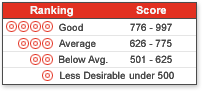
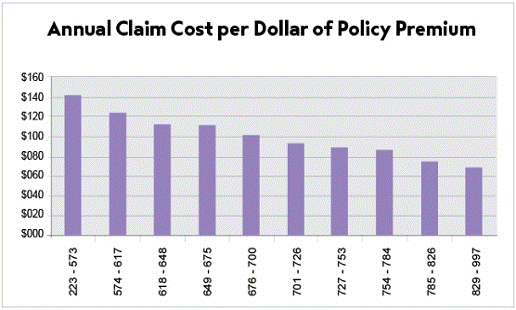
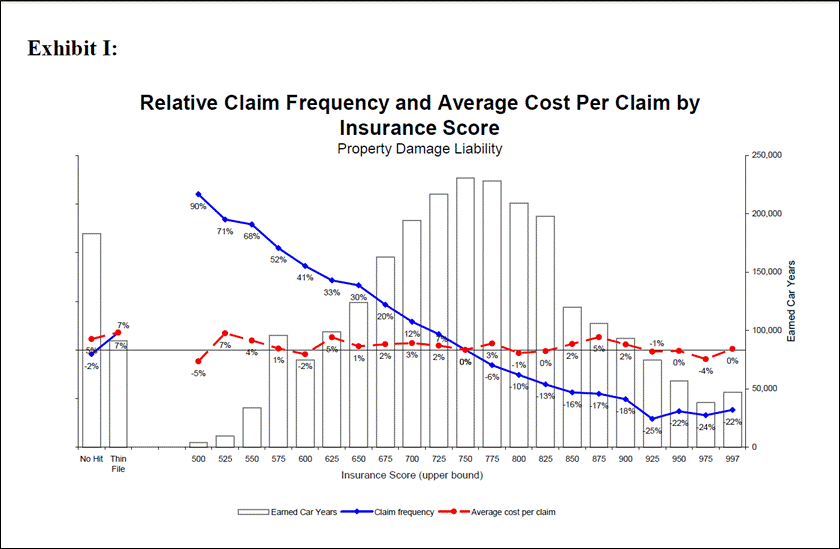
I came across a few different tables/charts with LN CBIS scores being categorized into ranges for insurance premiums. Some of this has been posted on other threads. However, not much help/value without checking score. The real hurt on premiums starts when CBIS is below 700 [or 625]. Here are a few breakdowns. The 1st table is from LN. The 2nd image is an actual category breakdown from an insurance company and the 3rd from an independent study:
Fico 9: .......EQ 850 TU 850 EX 850
Fico 8: .......EQ 850 TU 850 EX 850
Fico 4 .....:. EQ 809 TU 823 EX 830 EX Fico 98: 842
Fico 8 BC:. EQ 892 TU 900 EX 900
Fico 8 AU:. EQ 887 TU 897 EX 899
Fico 4 BC:. EQ 826 TU 858, EX Fico 98 BC: 870
Fico 4 AU:. EQ 831 TU 872, EX Fico 98 AU: 861
VS 3.0:...... EQ 835 TU 835 EX 835
CBIS: ........EQ LN Auto 940 EQ LN Home 870 TU Auto 902 TU Home 950
Fico 8: .......EQ 850 TU 850 EX 850
Fico 4 .....:. EQ 809 TU 823 EX 830 EX Fico 98: 842
Fico 8 BC:. EQ 892 TU 900 EX 900
Fico 8 AU:. EQ 887 TU 897 EX 899
Fico 4 BC:. EQ 826 TU 858, EX Fico 98 BC: 870
Fico 4 AU:. EQ 831 TU 872, EX Fico 98 AU: 861
VS 3.0:...... EQ 835 TU 835 EX 835
CBIS: ........EQ LN Auto 940 EQ LN Home 870 TU Auto 902 TU Home 950
Message 20 of 32
0
Kudos
† Advertiser Disclosure: The offers that appear on this site are from third party advertisers from whom FICO receives compensation.