Options
- Subscribe to RSS Feed
- Mark Topic as New
- Mark Topic as Read
- Float this Topic for Current User
- Bookmark
- Subscribe
- Mute
- Printer Friendly Page
Turn on suggestions
Auto-suggest helps you quickly narrow down your search results by suggesting possible matches as you type.
Showing results for
Discover scores?


Is your credit card giving you the perks you want?
Browse credit cards from a variety of issuers to see if there's a better card for you.
- « Previous
-
- 1
- 2
- Next »

Anonymous
Not applicable
- Mark as New
- Bookmark
- Subscribe
- Mute
- Subscribe to RSS Feed
- Permalink
- Report Inappropriate Content
12-28-2016
07:45 PM
12-28-2016
07:45 PM
Re: Discover scores?
I really like the way that Citi offers a free EQ FICO 8 Bankcard Enhanced score. It's not exactly the same model as FICO 8 Classic, but then again it's worth noting that FICO 8 Classic is not the same model across all three bureaus. I.e. EQ FICO 8 is a slightly different scoring model from TU FICO 8 and again from EX FICO 8.
And when one is relying on scores from credit cards or other free sources, it almost always means the scores are being pulled at different times during the month, so even if the model were exactly the same we'd see variability.
So I have come around to liking the fact that I have with Citi both a window into my EQ score and a window into how the BE flavor behaves.
Message 11 of 17
Anonymous
Not applicable
- Mark as New
- Bookmark
- Subscribe
- Mute
- Subscribe to RSS Feed
- Permalink
- Report Inappropriate Content
12-29-2016
06:28 AM
12-29-2016
06:28 AM
Re: Discover scores?
CGID,
How does your EQ BE score compare to your EQ FICO 08 score, generally speaking? Are there specific categories or factors that the BE model weighs differently than FICO 08?
Message 12 of 17
0
Kudos
Anonymous
Not applicable
- Mark as New
- Bookmark
- Subscribe
- Mute
- Subscribe to RSS Feed
- Permalink
- Report Inappropriate Content
12-29-2016
07:50 AM
12-29-2016
07:50 AM
Re: Discover scores?
I have very little hard evidence, since I have only seen my EQ FICO 8 Classic and EQ FICO 8 BE pulled on the same day once. That was 18 months ago when I subscribed to the $30 myFICO product and then cancelled a week later.
The results were what you'd expect for a profile like mine. My Classic score was 836 and my BE was therefore higher at 854 (ceiling for Classic is 850 and celing for BE is 900).
That was back when I had 4 credit cards. I have added 7 more cards in the last 16 months, and you'd think that adding lots of credit cards would cause the BE score to be especially inclined to dive due to perceived risk, but it hasn't. It's gone down some but my TU Classic score (for example) has gone down more. I have always had ultralow utilization.
I will get to see another snapshot in early April when I add the $30 MF package again (and then cancel). I am curious to see what my mortgage scores are since all the new cards were added, and I will get to see my FICO 9 for the first time.
The thing I am most interested in is whether lenders who use the BE score rather than Classic tend to have the same cutoffs for best rates. In other words if 10 card issuers who use Classic tend to have an average cutoff of 740 (730-750 say), will ten issuers who use BE have a slightly higher cutoff on average (745 say with a spread of 730-760)? This given that BE's ceiling runs up to 900. What I'd like to hear (just on practical grounds) is that the difference, if one exists, is small.
Message 13 of 17

- Mark as New
- Bookmark
- Subscribe
- Mute
- Subscribe to RSS Feed
- Permalink
- Report Inappropriate Content
12-29-2016
08:29 AM
12-29-2016
08:29 AM
Re: Discover scores?
@Anonymous wrote:I have very little hard evidence, since I have only seen my EQ FICO 8 Classic and EQ FICO 8 BE pulled on the same day once. That was 18 months ago when I subscribed to the $30 myFICO product and then cancelled a week later.
The results were what you'd expect for a profile like mine. My Classic score was 836 and my BE was therefore higher at 854 (ceiling for Classic is 850 and celing for BE is 900).
That was back when I had 4 credit cards. I have added 7 more cards in the last 16 months, and you'd think that adding lots of credit cards would cause the BE score to be especially inclined to dive due to perceived risk, but it hasn't. It's gone down some but my TU Classic score (for example) has gone down more. I have always had ultralow utilization.
I will get to see another snapshot in early April when I add the $30 MF package again (and then cancel). I am curious to see what my mortgage scores are since all the new cards were added, and I will get to see my FICO 9 for the first time.
The thing I am most interested in is whether lenders who use the BE score rather than Classic tend to have the same cutoffs for best rates. In other words if 10 card issuers who use Classic tend to have an average cutoff of 740 (730-750 say), will ten issuers who use BE have a slightly higher cutoff on average (745 say with a spread of 730-760)? This given that BE's ceiling runs up to 900. What I'd like to hear (just on practical grounds) is that the difference, if one exists, is small.
Generally my Bankcard 8's run like this:
EX & TU around 30 points higher than my FICO 8
EQ around 10 points higher than my FICO 8


















Total revolving limits 568220 (504020 reporting) FICO 8: EQ 689 TU 691 EX 682
Message 14 of 17
0
Kudos

- Mark as New
- Bookmark
- Subscribe
- Mute
- Subscribe to RSS Feed
- Permalink
- Report Inappropriate Content
12-29-2016
08:31 AM
12-29-2016
08:31 AM
Re: Discover scores?
Won't be consistent UW standards as those are set by individual lenders based on their individual datasets, and vary by product too in addition to in the time domain. Not really sure if it's meaningful given that it's not a single determination in UW so the FICO score is likely set "low" in many cases to let income and other things have a say.
If you have a well balanced file the two are pretty similar; reason code order is really the only way to suggest different weightings... and looking at a recent EX report that I pulled when my lien was off EX FICO 2 BC was complaining about my revolving balances in slot 4 (yawn) which was probably my HELOC balance vs EX FICO 2 baseline did not. I tend to trend marginally higher (+10 points or so) on various BC industry options, presumably from the fact it's scored out of 900.
Just noticed an idiosyncracy on the 1B report don't seem to get all of the reason codes for FICO 8 classic: that sucks.















Message 15 of 17

- Mark as New
- Bookmark
- Subscribe
- Mute
- Subscribe to RSS Feed
- Permalink
- Report Inappropriate Content
12-29-2016
08:42 AM
12-29-2016
08:42 AM
Re: Discover scores?
@Anonymous wrote:I have very little hard evidence, since I have only seen my EQ FICO 8 Classic and EQ FICO 8 BE pulled on the same day once. That was 18 months ago when I subscribed to the $30 myFICO product and then cancelled a week later.
The results were what you'd expect for a profile like mine. My Classic score was 836 and my BE was therefore higher at 854 (ceiling for Classic is 850 and celing for BE is 900).
That was back when I had 4 credit cards. I have added 7 more cards in the last 16 months, and you'd think that adding lots of credit cards would cause the BE score to be especially inclined to dive due to perceived risk, but it hasn't. It's gone down some but my TU Classic score (for example) has gone down more. I have always had ultralow utilization.
I will get to see another snapshot in early April when I add the $30 MF package again (and then cancel). I am curious to see what my mortgage scores are since all the new cards were added, and I will get to see my FICO 9 for the first time.
The thing I am most interested in is whether lenders who use the BE score rather than Classic tend to have the same cutoffs for best rates. In other words if 10 card issuers who use Classic tend to have an average cutoff of 740 (730-750 say), will ten issuers who use BE have a slightly higher cutoff on average (745 say with a spread of 730-760)? This given that BE's ceiling runs up to 900. What I'd like to hear (just on practical grounds) is that the difference, if one exists, is small.
Best I can tell is Bankcard enhanced version is somewhat more sensitive to number (or %) of cards reporting than is the Classic version. I would not expect adding new cards to negatively impact Fico Bankcard enhanced more than Fico Classic. Actually, BC enhanced should view a few more open accounts as a long term plus (even if there is a short term score drop).
CGID -
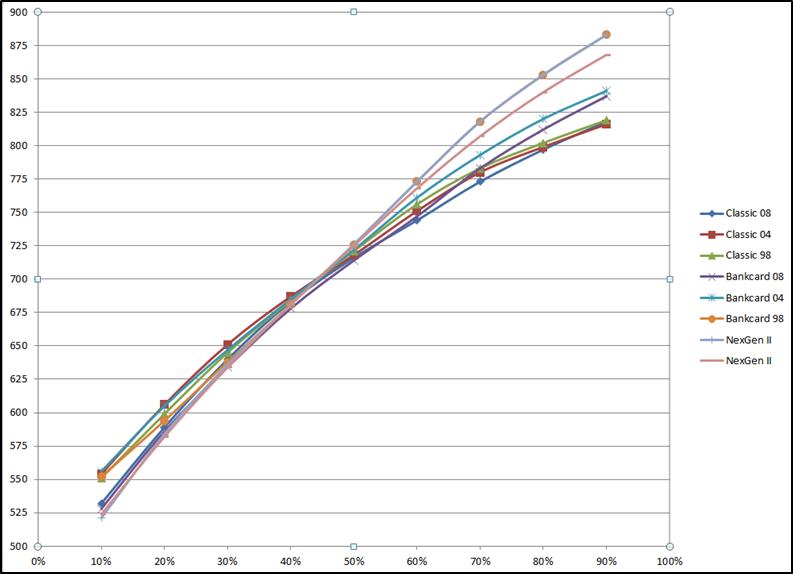
Experian data shows Fico 08 Bankcard enhanced and Classic scores track closely (for the population in aggregate) in the 20th to 70th percentile range (say scores between 600 and 780). Significant divergence between the algorithms becomes noticeable above 780 and below 580.
My EQ Fico 08 Bankcard score is typically 30 to 40 points above my EQ Fico 08 Classic
My TU and EX Fico 08 Bankcard scores are typically 40 to 50 points above their Classic counterparts.
Side note: It appears that all the Fico models were designed to converge at the 45th to 50th percentile with a score of 700 to 710. Based on the below curves, my guess is there may be no difference in "cutoff" for Fico 08 Classic vs Bankcard.
Fico 9: .......EQ 850 TU 850 EX 850
Fico 8: .......EQ 850 TU 850 EX 850
Fico 4 .....:. EQ 809 TU 823 EX 830 EX Fico 98: 842
Fico 8 BC:. EQ 892 TU 900 EX 900
Fico 8 AU:. EQ 887 TU 897 EX 899
Fico 4 BC:. EQ 826 TU 858, EX Fico 98 BC: 870
Fico 4 AU:. EQ 831 TU 872, EX Fico 98 AU: 861
VS 3.0:...... EQ 835 TU 835 EX 835
CBIS: ........EQ LN Auto 940 EQ LN Home 870 TU Auto 902 TU Home 950
Fico 8: .......EQ 850 TU 850 EX 850
Fico 4 .....:. EQ 809 TU 823 EX 830 EX Fico 98: 842
Fico 8 BC:. EQ 892 TU 900 EX 900
Fico 8 AU:. EQ 887 TU 897 EX 899
Fico 4 BC:. EQ 826 TU 858, EX Fico 98 BC: 870
Fico 4 AU:. EQ 831 TU 872, EX Fico 98 AU: 861
VS 3.0:...... EQ 835 TU 835 EX 835
CBIS: ........EQ LN Auto 940 EQ LN Home 870 TU Auto 902 TU Home 950
Message 16 of 17
Anonymous
Not applicable
- Mark as New
- Bookmark
- Subscribe
- Mute
- Subscribe to RSS Feed
- Permalink
- Report Inappropriate Content
12-29-2016
09:42 AM
12-29-2016
09:42 AM
Re: Discover scores?
Thanks TT! Very helpful.
Message 17 of 17
0
Kudos
† Advertiser Disclosure: The offers that appear on this site are from third party advertisers from whom FICO receives compensation.