- myFICO® Forums
- FICO Scoring and Other Credit Topics
- Understanding FICO® Scoring
- Point Drop Datapoint for 62% UTI
Options
- Subscribe to RSS Feed
- Mark Topic as New
- Mark Topic as Read
- Float this Topic for Current User
- Bookmark
- Subscribe
- Mute
- Printer Friendly Page
Turn on suggestions
Auto-suggest helps you quickly narrow down your search results by suggesting possible matches as you type.
Showing results for
Point Drop Datapoint for 62% UTI


Is your credit card giving you the perks you want?
Browse credit cards from a variety of issuers to see if there's a better card for you.

- Mark as New
- Bookmark
- Subscribe
- Mute
- Subscribe to RSS Feed
- Permalink
- Report Inappropriate Content
08-10-2026
03:08 PM
08-10-2026
03:08 PM
Re: Point Drop Datapoint for 62% UTI
@Thomas_Thumb wrote:I would expect taking aggregate utilization over 50% vs under 5% to cost 25-35 points on a clean scorecard with total point loss on Classic Fico 8 likely 35-45 points. Other balance reporting factors contribute to overall point loss being high card utilization and likely high dollar balance. Of course, if TCL is under $4k. a high reported aggregate balance may not come into play which reduces point loss potential.
I think those are realistic ballparks. I was more referring to just the crossing of the 50% threshold point though for aggregate, not multiple thresholds or with any other factors being at play.
Slightly off topic question for you, @Thomas_Thumb. Have you seen any data or testing done with the "stacking" of multiple individual elevated utilization cards being more adversely score-impacting beyond just one? I know the old discussion on here was aggregate utilization verses "highest individual utiliziation card" with really no consideration beyond that. What I mean is if you isolate aggregate utilization to a certain range such that a threshold will not be crossed (eliminating it as a variable) and you look at just individual cards, have you seen additional penalties incurred for more cards crossing individual threshold points? For example, highest individual utilization card is at (say) 80%. One has 5 other cards all under (say) 50%. They take one above 50%, then another above 50%. Naturally, neither of those is "highest individual utilization card" since the 80% card is already accounting for that. What sort of penalties have you seen imposed with just individual cards crossing other thresholds like in this example? This is removing any other variables from the equation like AWB%, raw dollars, aggregate utilization, etc.
Message 31 of 86
0
Kudos

- Mark as New
- Bookmark
- Subscribe
- Mute
- Subscribe to RSS Feed
- Permalink
- Report Inappropriate Content
08-10-2026
04:35 PM
08-10-2026
04:35 PM
Re: Point Drop Datapoint for 62% UTI
I have seen some data where highest individual card UT was something North of 70% and 2-3 cards were in the 50% - 60% range. A couple 50-60% cards were subsequently paid down to below 40% with no score improvement. In this situation the highest card UT had a 0% promo apr so the financial incentive was lowering balances on other cards.
SJ was always adamant that # of accounts at elevated utilization makes a difference. For example, if 4 cards are all in the 50%-55% UT range (none at a higher UT threshold) and 2 are paid down to a lower level then his score would increase. His file was quite active and he had over 2 dozen open revolvers. It was unclear if other scoring factor thresholds could have been crossed.
Generally speaking, reported data of this type has been confounded by other file changes.
In summary, data is limited either way and lacks multi-source validation or demonstrated repeatability.
Fico 9: .......EQ 850 TU 850 EX 850
Fico 8: .......EQ 850 TU 850 EX 850
Fico 4 .....:. EQ 809 TU 823 EX 830 EX Fico 98: 842
Fico 8 BC:. EQ 892 TU 900 EX 900
Fico 8 AU:. EQ 887 TU 897 EX 899
Fico 4 BC:. EQ 826 TU 858, EX Fico 98 BC: 870
Fico 4 AU:. EQ 831 TU 872, EX Fico 98 AU: 861
VS 3.0:...... EQ 835 TU 835 EX 835
CBIS: ........EQ LN Auto 940 EQ LN Home 870 TU Auto 902 TU Home 950
Fico 8: .......EQ 850 TU 850 EX 850
Fico 4 .....:. EQ 809 TU 823 EX 830 EX Fico 98: 842
Fico 8 BC:. EQ 892 TU 900 EX 900
Fico 8 AU:. EQ 887 TU 897 EX 899
Fico 4 BC:. EQ 826 TU 858, EX Fico 98 BC: 870
Fico 4 AU:. EQ 831 TU 872, EX Fico 98 AU: 861
VS 3.0:...... EQ 835 TU 835 EX 835
CBIS: ........EQ LN Auto 940 EQ LN Home 870 TU Auto 902 TU Home 950
Message 32 of 86
0
Kudos
- Mark as New
- Bookmark
- Subscribe
- Mute
- Subscribe to RSS Feed
- Permalink
- Report Inappropriate Content
08-10-2026
05:32 PM
08-10-2026
05:32 PM
Re: Point Drop Datapoint for 62% UTI
I certainly think more testing needs to be done on the subject, no doubt, and of course in clean fashion.
This thread may be of interest to you. It's by soonersoldier who I know you are familiar with. He's always extremely thorough with any testing he does and is quick to call himself out if data points may be conflated or if other variables are going on. I'd be curious to hear your take on the information he has presented here.
https://www.reddit.com/r/CRedit/comments/1vhob7k/amount_of_debt_category_data_points_does/
As for SJ, as much as he may have this one "right" (I'm not saying he does, but he may) I do find it difficult to accept his data points when he's been completely adament that raw dollar thresholds aren't a thing (when we know with absolute certainty that they are) but rather utilization threshold points exist at every single percentage point in his view.
Message 33 of 86
0
Kudos
- Mark as New
- Bookmark
- Subscribe
- Mute
- Subscribe to RSS Feed
- Permalink
- Report Inappropriate Content
08-11-2026
07:20 AM
08-11-2026
07:20 AM
Re: Point Drop Datapoint for 62% UTI
I looked at the link and data. I'd be more inclined to think it supports an aggregate utilization threshold at nominally 19%. There have been a few past discussions on 19% as a possibility on these forums. Perhaps your poster could do some follow-up testing going from under just under 19% AG UT to just above 20% while holding elevated individual card UTs in their respective categories.
You may recall the below graph posted back in 2016. The data points, provided by another poster, were for a single card profile. I connected the dots for illustration. Various interpretations could be made with this data on possible aggregate utilization thresholds.
The linear portion between 9% and 30% with data points at 9%, 19% and 30% could have also been depicted as 2 or more step changes. The issue is where to insert step changes. Was the score drop at 19% UT due to crossing a threshold at 9%? Was the UT score drop at 30% due to a threshold at 29% or 30%? Score was the same at 30%. Score at 49% was the same as score at 55%. Lower score at 80% depicts a drop at a 70% threshold but that's an assumption. A lot to speculate on thresholds with this data.
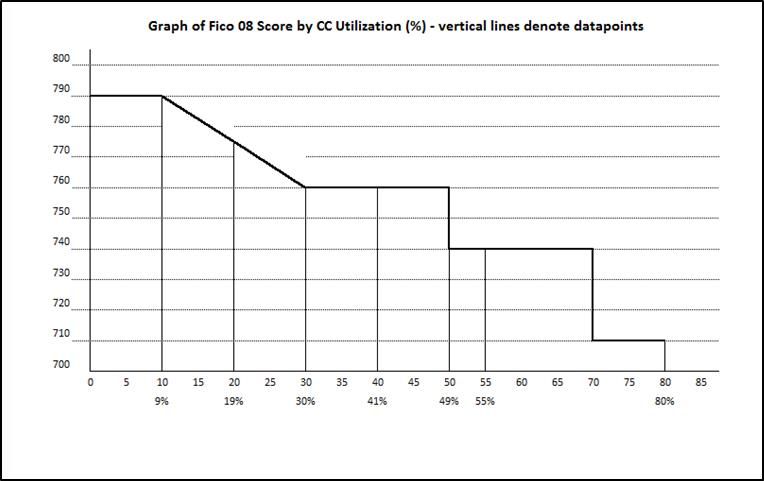
Graph with data points only

Fico 9: .......EQ 850 TU 850 EX 850
Fico 8: .......EQ 850 TU 850 EX 850
Fico 4 .....:. EQ 809 TU 823 EX 830 EX Fico 98: 842
Fico 8 BC:. EQ 892 TU 900 EX 900
Fico 8 AU:. EQ 887 TU 897 EX 899
Fico 4 BC:. EQ 826 TU 858, EX Fico 98 BC: 870
Fico 4 AU:. EQ 831 TU 872, EX Fico 98 AU: 861
VS 3.0:...... EQ 835 TU 835 EX 835
CBIS: ........EQ LN Auto 940 EQ LN Home 870 TU Auto 902 TU Home 950
Fico 8: .......EQ 850 TU 850 EX 850
Fico 4 .....:. EQ 809 TU 823 EX 830 EX Fico 98: 842
Fico 8 BC:. EQ 892 TU 900 EX 900
Fico 8 AU:. EQ 887 TU 897 EX 899
Fico 4 BC:. EQ 826 TU 858, EX Fico 98 BC: 870
Fico 4 AU:. EQ 831 TU 872, EX Fico 98 AU: 861
VS 3.0:...... EQ 835 TU 835 EX 835
CBIS: ........EQ LN Auto 940 EQ LN Home 870 TU Auto 902 TU Home 950
Message 34 of 86
0
Kudos

- Mark as New
- Bookmark
- Subscribe
- Mute
- Subscribe to RSS Feed
- Permalink
- Report Inappropriate Content
08-11-2026
07:55 AM
08-11-2026
07:55 AM
Re: Point Drop Datapoint for 62% UTI
Some even believe there is an aggregate utilization threshold at 5% I don't remember the data to support this but I know I have seen it before.
although I can't say I've ever seen much proof of the 20% threshold.







Message 35 of 86
0
Kudos
- Mark as New
- Bookmark
- Subscribe
- Mute
- Subscribe to RSS Feed
- Permalink
- Report Inappropriate Content
08-11-2026
09:08 AM
08-11-2026
09:08 AM
Re: Point Drop Datapoint for 62% UTI
There have been plenty of data points submitted by posters showing a score change around 5% (possibly 4.5%) AG UT. I saw this myself although my data is not clean due to # cards with balances not constant. I'll look at my records to check details - I recall checking # cards with balances using official CRA reports. Though I added that to a summary table.
Agreed, it's hard to have proof without proper testing. In the posters case taking AG UT from slightly below 19% to slightly above 20% would be best. If the threshold could be 19%, 19.5% or 20% you want to cross all 3 at the same time. Then obtain score and if it dropped reduce utilization to see if points come back.
Fico 9: .......EQ 850 TU 850 EX 850
Fico 8: .......EQ 850 TU 850 EX 850
Fico 4 .....:. EQ 809 TU 823 EX 830 EX Fico 98: 842
Fico 8 BC:. EQ 892 TU 900 EX 900
Fico 8 AU:. EQ 887 TU 897 EX 899
Fico 4 BC:. EQ 826 TU 858, EX Fico 98 BC: 870
Fico 4 AU:. EQ 831 TU 872, EX Fico 98 AU: 861
VS 3.0:...... EQ 835 TU 835 EX 835
CBIS: ........EQ LN Auto 940 EQ LN Home 870 TU Auto 902 TU Home 950
Fico 8: .......EQ 850 TU 850 EX 850
Fico 4 .....:. EQ 809 TU 823 EX 830 EX Fico 98: 842
Fico 8 BC:. EQ 892 TU 900 EX 900
Fico 8 AU:. EQ 887 TU 897 EX 899
Fico 4 BC:. EQ 826 TU 858, EX Fico 98 BC: 870
Fico 4 AU:. EQ 831 TU 872, EX Fico 98 AU: 861
VS 3.0:...... EQ 835 TU 835 EX 835
CBIS: ........EQ LN Auto 940 EQ LN Home 870 TU Auto 902 TU Home 950
Message 36 of 86
0
Kudos
- Mark as New
- Bookmark
- Subscribe
- Mute
- Subscribe to RSS Feed
- Permalink
- Report Inappropriate Content
08-11-2026
10:08 AM
08-11-2026
10:08 AM
Re: Point Drop Datapoint for 62% UTI
@Thomas_Thumb while I certainly wouldn't rule out 20% as a threshold point, I feel we would have seen more instances of it referenced over the years if it were in fact a thing. Naturally the lower the percentages, the odds of hitting/testing them increases. If we have ample data on 30%, there should only be more for 20% IMO. Again, not saying it isn't possible, but on that profile in question (scorecard) with plenty of others in the same boat there should be data on it.
Do you think that the "stacking" of multiple individual cards beyond known threshold points definitely isn't a thing, or do you simply believe more testing needs to be done on it?
The biggest issue I see with testing utilization percentages that are relatively low (5%, 10%, 20%, even 30% at times) is that they are often conflated with other variables. You mentioned AWB%, which is a common/good example. Another that we've discussed in the past are raw dollar thresholds. If a raw dollar threshold lands right around 20% for someone, it's going to make testing that utilization percentage pretty tough.
Message 37 of 86
0
Kudos
- Mark as New
- Bookmark
- Subscribe
- Mute
- Subscribe to RSS Feed
- Permalink
- Report Inappropriate Content
08-11-2026
11:51 AM
08-11-2026
11:51 AM
Re: Point Drop Datapoint for 62% UTI
couple random recent data points I would like to add to this discussion
1) couple weeks ago I had a very small Capital One balance report, but I went to 75% awb on equifax and it cost me 19 points
2) back in May I had a small balance report went from $3700 in total balances to 4200 and I lost 8 points no utilization thresholds crossed ( it's also worth noting that when I went from $200 in total balances up to 3700. I only lost 1 point, so on my profile it seems like $4000 is a dollar amount threshold)
3) I allowed my Amex to report at 20% 2 times. The first time my total combined balances were under 4,000, and I lost 4 points. The second time, my total combine balances were over 4,000 and I lost 7 points. So was the extra 3 points related to the $4000 dollar amount threshold? Seems like it
4) I allowed my capital one card to report at 54% individual (over 50% threshold) and lost 7 points (the same amount of points I lost when it reported under 50% individual) so going over 50% did not cause any additional score drop
just a couple data points I found interesting
Message 38 of 86
0
Kudos
- Mark as New
- Bookmark
- Subscribe
- Mute
- Subscribe to RSS Feed
- Permalink
- Report Inappropriate Content
08-11-2026
12:35 PM
08-11-2026
12:35 PM
Re: Point Drop Datapoint for 62% UTI
Ok, as a follow-up to comments on a 4.5%-6% AG UT and a $4k-$5k total balance threshold. Posted below is my data with additional info. I now include cards reporting balances (even though QTY does not come into play on Experian Fico 8).
For S&G I also added high card UT%, total balance including AU card and AG UT including the AU account. Fico 8/9/10 do not consider AU cards in AG UT % calculations. However the older Fico algorithms 5/4/3/2 and VS 3/4 do include AUs.
Note: My AMEX charge card is included in total balance and QTY of cards with balances but not utilization.

Rows of data associated with significant score changes are bolded. Aggregate utilization going to 6.52% (from 3.92%) coupled with total balance increasing to $5765 (from $3337) resulted in a 10 point score drop. Previous to the baseline month, score had actually been 1 point higher although reported balance was $3760 and utilization was 4.39%. This indicates that the total balance threshold exceeds $3760 and the AG UT threshold is above 4.39%.
The end of Oct data shows score had returned to pre drop level while reporting a $3377 balance and 3.97% AG UT. This shows repeatability.
** Some people think there is a high card UT threshold at 9%. Although my high card UT reached 12.6% during the spike, it had been above 10% three other times with no negative impact. The score drop and subsequent increase relates directly to changes in aggregate utilization and total balance.
AMEX did a mid month pull in Oct for another score. No idea why they did that and no associated balance data. However, I had regained 5 of the 10 points lost. My conclusion is the mid cycle point gain was for total balance dropping or a reduction in AG UT due to payoff of a card(s). The subsequent 5 point gain then resulted from the other factor's threshold being crossed.
A couple possible 2-step threshold scenarios are:
1. TB drops to slightly below $5k TB threshold and then AG UT falls to 3.97% crossing a AG UT threshold between 4.5% and 5.5%.
2. AG UT drops below a UT threshold between 5% to 6% and then TB drops to $3370 crossing a TB threshold between $3.8k and $4.2k.
If @SRT4kid93 datapoint is added (mentions $3.7k => $4.2k TB causing a score drop), then only scenerio #2 is in play for my 2 step point gain.
P.S. Not seeing the reported TB threshold around $2k with my data.
Fico 9: .......EQ 850 TU 850 EX 850
Fico 8: .......EQ 850 TU 850 EX 850
Fico 4 .....:. EQ 809 TU 823 EX 830 EX Fico 98: 842
Fico 8 BC:. EQ 892 TU 900 EX 900
Fico 8 AU:. EQ 887 TU 897 EX 899
Fico 4 BC:. EQ 826 TU 858, EX Fico 98 BC: 870
Fico 4 AU:. EQ 831 TU 872, EX Fico 98 AU: 861
VS 3.0:...... EQ 835 TU 835 EX 835
CBIS: ........EQ LN Auto 940 EQ LN Home 870 TU Auto 902 TU Home 950
Fico 8: .......EQ 850 TU 850 EX 850
Fico 4 .....:. EQ 809 TU 823 EX 830 EX Fico 98: 842
Fico 8 BC:. EQ 892 TU 900 EX 900
Fico 8 AU:. EQ 887 TU 897 EX 899
Fico 4 BC:. EQ 826 TU 858, EX Fico 98 BC: 870
Fico 4 AU:. EQ 831 TU 872, EX Fico 98 AU: 861
VS 3.0:...... EQ 835 TU 835 EX 835
CBIS: ........EQ LN Auto 940 EQ LN Home 870 TU Auto 902 TU Home 950
Message 39 of 86
0
Kudos
- Mark as New
- Bookmark
- Subscribe
- Mute
- Subscribe to RSS Feed
- Permalink
- Report Inappropriate Content
08-11-2026
01:15 PM
08-11-2026
01:15 PM
Re: Point Drop Datapoint for 62% UTI
@BrutalBodyShots wrote:@Thomas_Thumb while I certainly wouldn't rule out 20% as a threshold point, I feel we would have seen more instances of it referenced over the years if it were in fact a thing. Naturally the lower the percentages, the odds of hitting/testing them increases. If we have ample data on 30%, there should only be more for 20% IMO.
Do you think that the "stacking" of multiple individual cards beyond known threshold points definitely isn't a thing, or do you simply believe more testing needs to be done on it?
I don't rule out the possibility of stacking but, I would hesitate drawing such conclusions from the data in that link. Some of the score swings seem excessive for the stacking change described while the high card remains above 80%. As mentioned, I recall reading a poster seeing no score gain taking one or two lower tier UT cards a notch while maintaining a 0% promo card above 70%.
It would be useful to see supporting data from other files with no recent account additions or HPs.
P.S. We have hijacked the OP's thread. His questioned was answered long ago.
Fico 9: .......EQ 850 TU 850 EX 850
Fico 8: .......EQ 850 TU 850 EX 850
Fico 4 .....:. EQ 809 TU 823 EX 830 EX Fico 98: 842
Fico 8 BC:. EQ 892 TU 900 EX 900
Fico 8 AU:. EQ 887 TU 897 EX 899
Fico 4 BC:. EQ 826 TU 858, EX Fico 98 BC: 870
Fico 4 AU:. EQ 831 TU 872, EX Fico 98 AU: 861
VS 3.0:...... EQ 835 TU 835 EX 835
CBIS: ........EQ LN Auto 940 EQ LN Home 870 TU Auto 902 TU Home 950
Fico 8: .......EQ 850 TU 850 EX 850
Fico 4 .....:. EQ 809 TU 823 EX 830 EX Fico 98: 842
Fico 8 BC:. EQ 892 TU 900 EX 900
Fico 8 AU:. EQ 887 TU 897 EX 899
Fico 4 BC:. EQ 826 TU 858, EX Fico 98 BC: 870
Fico 4 AU:. EQ 831 TU 872, EX Fico 98 AU: 861
VS 3.0:...... EQ 835 TU 835 EX 835
CBIS: ........EQ LN Auto 940 EQ LN Home 870 TU Auto 902 TU Home 950
Message 40 of 86
0
Kudos
† Advertiser Disclosure: The offers that appear on this site are from third party advertisers from whom FICO receives compensation.